
The Complete Halal Foods List: What to Eat, Avoid & How to Build a Halal Diet Food Plan
Whether you are new to living a halal lifestyle, cooking for a Muslim family member, or simply curious about what Islam halal food actually looks like on a day-to-day plate, the most practical question is almost always the same: what exactly can I eat?
Understanding the rules behind halal food is one thing. Having a clear, usable list of specific halal foods — organized by category, with guidance on what to watch out for — is something far more immediately useful. That is what this guide delivers.
Below you will find a complete breakdown of halal foods by category, a list of what to avoid, tips for reading ingredient labels, and a practical starting point for building a halal diet food plan that is both spiritually sound and nutritionally balanced.
What Makes a Food Halal in Islam?
Before diving into the list, a quick foundation is worth establishing. In Islam, halal food is any food that is permissible according to Islamic law as outlined in the Quran and Hadith. The word halal (حلال) means “permissible” in Arabic, and its opposite — haram (حرام) — means “forbidden.”
For food to qualify as halal, it must meet three core conditions:
- The source must be permitted. The animal or ingredient must itself be halal — pork and its by-products, for example, are never permissible regardless of how they are processed.
- The slaughter must follow Zabiha. For meat to be halal, the animal must be slaughtered by a sane Muslim adult who recites “Bismillah, Allahu Akbar,” using a sharp blade with a single cut to the throat, and the blood must be fully drained.
- No forbidden substances may be present. Alcohol, blood, and haram derivatives must be absent from the food or its preparation.
For a deeper understanding of the Islamic foundations behind these rules, our guide on what is halal food covers the religious, cultural, and historical context in full.
The Complete Halal Foods List by Category
✅ Meat & Poultry (Halal)
This is the category where halal rules are most specific. The following meats are halal provided they are slaughtered according to Zabiha method:
- Chicken
- Turkey
- Duck and other domestic birds
- Beef and veal
- Lamb and mutton
- Goat
- Venison (deer)
- Rabbit
- Camel
- Buffalo
Key rule: Even if the animal itself is halal, meat purchased from a non-halal butcher or supermarket without halal certification is not considered halal. Always look for verified halal certification on packaging or confirm directly with your butcher.
✅ Seafood (Halal)
Seafood is broadly permissible in most schools of Islamic jurisprudence, making it one of the most straightforward halal food categories:
- All fish with scales (salmon, tuna, cod, tilapia, mackerel, sardines, sea bass, etc.)
- Shrimp and prawns
- Lobster, crab, and crayfish (permitted in most madhabs, though some scholars differ)
- Clams, oysters, and mussels (permitted under the Shafi’i and Hanbali schools)
Note: The Hanafi school of thought permits only fish and not other sea creatures, so if you follow the Hanafi madhab, stick to finned fish and confirm rulings on shellfish with your scholar.
✅ Fruits & Vegetables (Halal)
All fresh fruits and vegetables are inherently halal with no restrictions — one of the simplest categories in a halal diet food plan:
- All fresh, frozen, or dried fruits
- All fresh, frozen, or canned vegetables
- Legumes: lentils, chickpeas, beans, peas
- Nuts and seeds of all kinds
- Herbs and spices in their natural form
Watch for: Processed or pre-packaged versions of these foods may contain haram additives such as alcohol-based flavoring, non-halal gelatin in coatings, or lard in savory snacks. Always check the label on processed produce products.
✅ Grains & Starches (Halal)
- Rice, pasta, bread, and noodles (plain, without haram additives)
- Oats, barley, wheat, corn, and quinoa
- Flour of all types
- Breakfast cereals (check for alcohol-based flavorings or non-halal gelatin)
- Bread products (check for L-cysteine, which may be derived from non-halal sources)
✅ Dairy & Eggs (Halal)
- Eggs (from halal-permitted birds)
- Milk (cow, goat, sheep, camel)
- Butter and ghee (from halal animals, without alcohol additives)
- Cheese (with halal-certified or microbial/vegetable rennet — animal rennet from non-halal sources makes cheese haram)
- Yogurt, cream, and ice cream (check for gelatin and alcohol-based flavorings)
Important label check: Many cheeses use animal rennet. For a cheese to be part of your halal foods list, confirm it uses microbial, vegetable, or halal-certified animal rennet.
✅ Oils, Sauces & Condiments (Halal)
- Vegetable oils (olive, sunflower, canola, coconut, sesame)
- Vinegar (grain-based or apple cider — alcohol is transformed through fermentation so most scholars permit it)
- Tomato-based sauces and ketchup (without alcohol additives)
- Halal-certified soy sauce (regular soy sauce often contains trace alcohol from fermentation — look for halal-certified versions)
- Honey
- Salt, pepper, and natural spice blends
✅ Beverages (Halal)
- Water
- All pure fruit and vegetable juices
- Tea and coffee (without alcohol-based flavorings)
- Milk and plant-based milks
- Soft drinks (most are halal — check for alcohol-based flavoring in some artisan brands)
- Non-alcoholic versions of drinks labeled “0% alcohol” (check carefully — some retain trace amounts)
What Is Not Halal: The Haram Foods List
Understanding Islam halal food requires an equally clear picture of what falls outside those boundaries. The main categories of haram food are:
- Pork and all pork derivatives — bacon, ham, lard, gelatin from pork, pepsin from pork
- Alcohol and any food cooked with or containing alcohol — wine sauces, beer-battered fish, tiramisu, rum cake, vanilla extract in some forms
- Blood and blood products — black pudding, blood sausage
- Animals not slaughtered according to Zabiha — even otherwise-halal animals become haram if slaughtered incorrectly
- Carnivorous animals and birds of prey — lions, wolves, eagles, hawks
- Animals that died before slaughter — carrion
- Donkeys and mules
- Insects (with the exception of locusts in some scholarly opinions)
For a full exploration of the halal versus haram framework and how it extends beyond food into daily life, our guide on halal vs haram is an essential companion read.
How to Read Food Labels for Hidden Haram Ingredients
One of the biggest practical challenges of maintaining a halal diet food plan in Western countries is identifying hidden haram ingredients in processed foods. Labels do not always say “pork” or “alcohol” — you need to know the code words:
| Ingredient on Label | Potential Haram Source |
| Gelatin | Pork or non-halal beef — always verify source |
| Lard / Animal shortening | Pork fat |
| L-Cysteine (E920) | Often derived from pig hair or feathers |
| Carmine / Cochineal (E120) | Derived from insects |
| Rennet | May be from non-halal animal sources |
| Natural flavors | Can include alcohol-based extracts |
| Vanilla extract | Often alcohol-based — look for halal-certified versions |
| Mono and diglycerides | Can be derived from animal fat — source matters |
| Emulsifiers (E471, E472) | May be pork-derived |
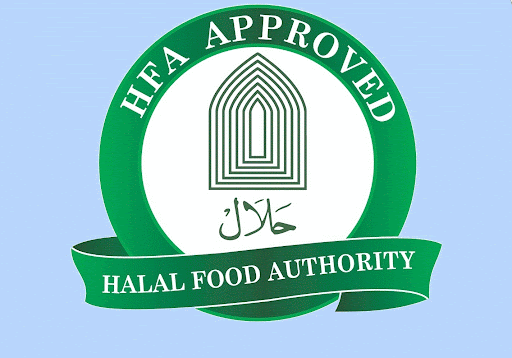
When in doubt, look for a recognized halal certification logo on the packaging. Our guide to major halal certification bodies explains which logos to trust — including IFANCA (USA), HFA (UK), JAKIM (Malaysia), and SANHA (South Africa).
Building a Practical Halal Diet Food Plan
With the full halal foods list in hand, building a daily halal diet food plan is straightforward. Here is a simple, balanced framework:
Breakfast: Eggs with vegetables, oats with fruit and honey, or whole-grain toast with halal-certified butter and fruit. Drink: Tea, coffee, or fresh juice.
Lunch: Grilled halal chicken or fish over rice or salad. Lentil soup with halal-certified bread. Add fresh vegetables and a dairy side like halal yogurt.
Dinner: Halal lamb or beef with roasted vegetables and a grain side. Seafood dishes such as grilled salmon or prawn curry are excellent protein-rich halal options.
Snacks: Fresh fruit, nuts, dates, halal-certified hummus with vegetables, or yogurt.
The halal diet food framework naturally encourages clean eating — lean proteins, whole grains, fresh produce, and minimal processed food — which is part of why it is gaining recognition among non-Muslim health-conscious eaters as well. For a detailed look at the nutritional benefits, our post on is halal food healthy breaks this down thoroughly.
Finding Halal Food Outside the Home
Knowing your halal foods list is essential, but so is knowing how to source halal food reliably — especially when travelling or living in an area where halal options are not widely labeled. Our complete guide on how to find halal food anywhere in the world covers the best apps, strategies, and tips for staying halal whether you are at home or abroad.
Final Thoughts
Halal food is not a restriction — it is a framework for eating with intention, purity, and gratitude. With a clear halal foods list across every major food category, practical label-reading skills, and a simple daily plan, building and maintaining a halal diet food routine becomes far more manageable than it might initially seem.
The beauty of Islam halal food is that it works with the full diversity of world cuisine. From South Asian biryani to Moroccan tagine, from Mediterranean seafood to American BBQ — the halal world is wide, flavorful, and welcoming. All it requires is knowing what you are looking for.
Explore more guides, recipes, restaurant tips, and lifestyle resources at Zabiha Food — your trusted source for everything halal.